
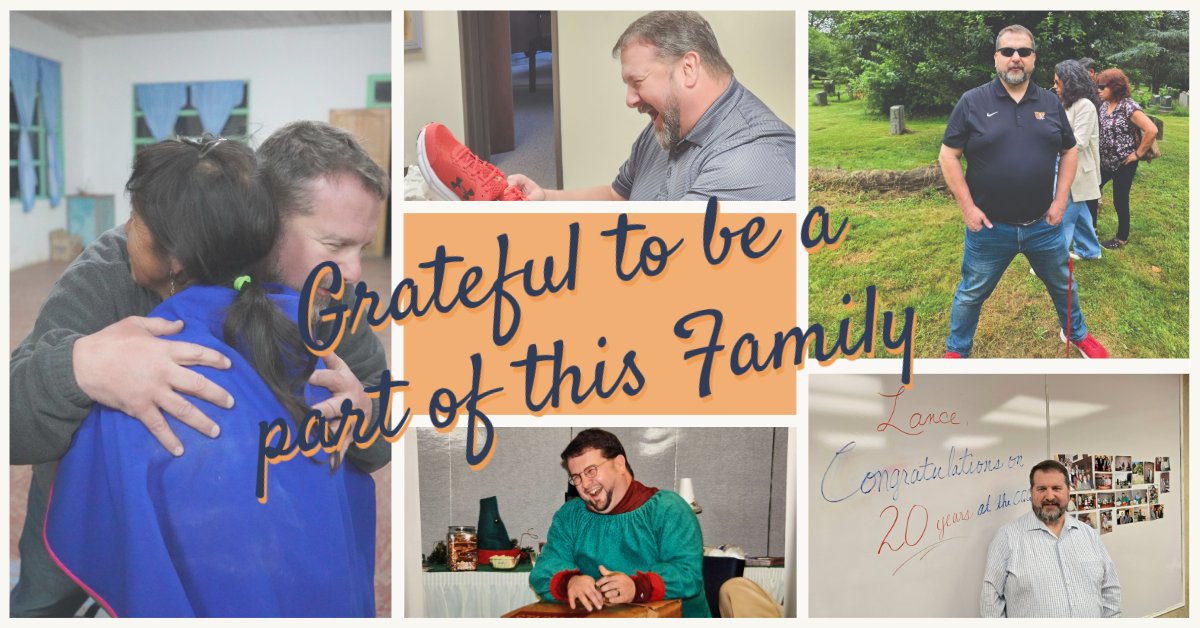
As of this week it's officially bee 20 years since Lance Finley stepped into this office in the role of Youth and Family Director. Now, 20 years later, Lance has been the Executive Director of the denomination for just over 10 years. He's seen a lot in his time here, and to celebrate his long tenure in the office, we've produced a lengthy interview with Lance. Below you can read about the myriad shifts and changes this office has gone through, as well Lance's personal life and the cultural at large.
As we said on Facebook recently, we're grateful for Lance's leadership and vision to see the kingdom built on strong relationships. Lance ensures that our team feels supported, our contributions valued, and our life outside of work cherished.
How does it feel to be at 20 years?
Yes. Well, obviously I'm older. And that does fit a certain way. When I came on staff 20 years ago, I wasn't the youngest director to ever come on staff, but I'm one of the younger directors. I was in my mid-30s, and I'm sure there were lots of people that thought, “that's a little young. Do you really bring experience or wisdom to lead at the national level.” And now the reality is I'm one of the older folks in the office.
One of the pictures that was on Facebook this week probably was from my first year or two in the office. And the reality of how much change we've undergone as an office. There's only three of us left from that time that I started.
What are some things either culturally, or in your life that are massively different since when you started? You weren't married and you didn't have any kids. Is that right?
I'd been married for about six months. When I was hired on I was a newlywed. It was in my second year that we welcomed Carter to the fold and then two years later Molly and two years later Connor. So, there's being a newly married husband, of being a dad for the first time, of being a dad of toddlers and all the phases. And now, it's not too far off over the horizon that we're looking at the empty nest and sending Carter off to college this fall.
I had a much darker hair color and certainly much darker beards than I do today. So, I’ve aged. I like to say a lot of that is my kids.
Culturally, that was a pre-COVID world… where Christianity had a preferred place in American culture and a sense of shared respect. Most people saw that as a good thing. But we're in a post-COVID world now, and the church often is not looked at from a place of respect or honor or being seen as a good thing culturally.
I think on a good front, one of the things over that 20-year period, we've continued to grow internationally, both in specific fields, planting churches, establishing new ministries, but also in the addition of new fields. When I came on, we were in South Asia, South Central Asia, Haiti, and Brazil. We've seen the addition of so many Latin American countries. Seeing the global picture grow and rightfully so, because the majority of the world is somewhere other than the United States.
I think we can be honest to say that didn't grow out of our strategic plans or something that we had on a board that we were targeting. The Lord's been very gracious, to open doors and opportunities to us.
Outside of the Churches of God and maybe even outside of like Christianity in general, what are some cultural changes that have made big shifts, like style of music or what’s on TV, etc.
The iPhone and smartphones in general. You'd have to fact check me on this, but I'm pretty sure that was still back in like the Blackberry era, when I came on board. That's revolutionized our society. Social media wasn't a thing. E-mail, the internet, we were all becoming accustomed to that, but just how much has changed because of technology and the rise of social media… that's really quite staggering, to be honest with you.
I don't think you can ignore the shifts that were made in COVID or maybe what COVID revealed. I think we're more divided now in ways than we were before. I think we've all seen that and can acknowledge that.
A lot of our planting in the 90s and the early 2000s certainly was targeted at re-engaging people that had stepped away, at least from the church, maybe even their faith, and re-engaging them. Over the last 20 years, we've observed that in a lot of places, it's not universal, but in a lot of contexts, the things we did then to establish new works have just become less and less effective.
So, I think it's a much longer runway for us to make a case for, wanting to reach people for Christ, that we have their best interest at heart. Trust comes slower, all of that.
Can you walk us through your time at the CGGC and what big ‘philosophies of ministry’ stand out to you?
Yeah. I think one of the big ones for me is the emphasis on mission or being missional. I think that requires an outward focus. I grew up in a world where people were more familiar with Christian faith, with church life. It really was a “you build it, they will come”. And over the years, as that has waned. That's where I think a lot of my work has been in my time at the General Conference, trying to help people understand that, help resource them for that.
Probably the surprise is, having been in that conversation or helping make that a shift for probably the better part of 15 years of my tenure, I'm still surprised that there are people just now waking up to the idea [that] our church has to get outside of ourselves and engage the community. They would have been resistant to that 10 years ago, now they see it, now they're open to it.
I think the office culture has shifted some. Even before I came on board, I know they had remote staff, but we've experimented with that even more so than we once did. And so that's a change where not everybody on our team lives in Findlay, Ohio or is in the office every day.
The one thing that hasn't changed that, [which] I think is a good thing, that speaks a little bit about the quality of people we've had, as well as I think the culture we have, is we've had some amazingly long tenures. I think Kris Cupp was at the top at like 43 years. And I know Roberta Bakies was somewhere in the 35-36 year range. Bob Stevenson was in that same range. And we had other support staff that served at the General Conference for 10 or 15 or 25 years. And even today, I've surpassed 20 years, but Darlene and Rachel have been here longer than me. I've always marveled at that sense of culture that we have. It's nice to be a part of this.
I think the other significant thing on the global front that's really changing is when I came on board, with many of our global works one of our strategies was to “go and see”. We regularly took people to foreign fields.
And the reality today is that's just getting harder and harder to take people places. With the situation in Haiti, which would have been one of the more popular destinations since it's close to the U.S., it's no longer a situation where we can take visitors from the United States.
Of course, our Asia fields are becoming much more difficult and restrictive as far as who gets in and so that's becoming more problematic. In places like Venezuela and Nicaragua, again, there's just an element of danger or difficulty that not only with the folks we take from the states maybe not be safe, but we'd also be putting our brothers and sisters in jeopardy there, or putting more hardship on them in trying to host teams from the states under very difficult situations. So, we've had to pivot.
Can you walk us through the different jobs you've had in this office?
I was hired as the Director of Youth and Family Ministry. A big piece of my responsibilities was pulling off Impact every summer.
Fairly early in my tenure, Wayne Boyer was actually the Executive Director that hired me, and Wayne had already announced his retirement which would come about a year and a half after I joined the CGGC. And so, Ed Rosenberry followed, and it was pretty early in the year that he had a burden to have us do more with leadership development.
And ultimately, it was decided, “hey, that probably fits your gift mix Lance. So, we're going to add that to your area of responsibility.” Some of the things that grew out of that were things like the Missional Leadership Initiative (MLI), launching that, overseeing that.
In those early years, they had decided to basically merge [Church Renewal and Church Planting]. We had one person overseeing both church planting and church renewal. Ultimately they decided that wasn't working as well as what they hoped and so the decision was made that “hey we're going to give you (Lance) church renewal and you figure out what to call it and what this is going to look like with everything else you're responsible for”, and so at that point a I tried to narrow the focus [to] mission, disciple-making, and leadership development, and chose to call that “Transformational Ministries”. So, we worked at that for a couple of years before I was invited to apply for the Executive Director's role, and I've served in that now for a little over 10 and a half years.
Can you talk to us a little about who your mentors were through all of this? Some of the important figures that influenced you?
Wow that's… a long list. Obviously, I've greatly benefited from a host of mentors over the years.
Thinking about specifically my time at the General Conference, whether they were called Executive Directors or Administrators, certainly [they] had an influence on my leadership. From the first one, Dick Wilkin, to Bill Reist, to Dave Draper, to, of course, Wayne and Ed that immediately preceded me. Each one of them invested in me, gave me opportunities, helped me glean various things from the way they led and the way they did ministry.
For my youth ministry years one of those folks was Saleem Ghubril. I met Salim when he was leading the ministry on the north side of Pittsburgh called the Pittsburgh Project. But Saleem, he's a mentor from afar, but certainly had a profound impact on me, like seeing the gospel lived out.
In my role as the Youth and Family Director, I remember maybe in my first or second year, getting invited to a denominational leaders meeting of various youth worker types and being starstruck. And the leader of the Nazarene Church's youth ministry effort, his name was Dave Curtiss, Dave took me under his wing. He said, “This is an intimidating room, but it's a good room. Stay with us. You're going to benefit from this connection.” And he was absolutely right. [Dave’s] a person I could pick up the phone and talk through different challenges with and was a wonderful resource.
Another person like that is Reggie McNeal. We brought Reggie in for 10 years to help us with the Missional Leadership Initiative. And Reggie has been one of those people in my life that is just a trusted mentor and advisor. I've been greatly blessed by my friendship and connection with him.
A couple denominational leaders that have been peers, one would be Todd Fetters, who's the bishop of the United Brethren Church. The other, he's no longer in the role, but Stephen Cole with the Church of the Brethren out of Ashland, Ohio. They are peers, and all of our journeys are fairly similar.
And then the last one I'd mention is John Upton, who was the Executive Director of the BGAV, the Baptist General Assembly of Virginia. When I'm at a place that I need some sound, godly, wise advice, he's been willing to serve in that role for me.
On the flip side, that's been my “aha” in the last two years of losing a couple of those folks. Dave Draper first, and then of course, Bill Reist. And the realization that mentors aren't easily replaceable, especially when you've come to the point in life that I'm at. And the importance of reverse mentoring, of realizing I need younger people in my world helping me understand the world that's emerging, that I don't necessarily easily understand.
Probably the last piece I'd add to that is just the clarity that as most of my mentors have passed away or are in the fading years of life, how much more seriously I need to become about investing in people that are 10 or 20 years behind me and offering what I have that would be of benefit to them.
Final question. How has your relationship with God deepened or changed over these 20 years?
When I was interviewing for this role 11 years ago, there was a question asked that stopped me in my tracks, and that was, “what's the hardest thing you've been through and what did you learn about it?” The “aha” to me was not that I live a charmed life but I just hadn't experienced a lot of pain. At that point in life all of my grandparents had died in old age. I hadn't lost anyone close to me before their time. My parents were both still living. I hadn't buried a friend.
I mentioned that to a mentor who jokingly said “maybe this job will be the toughest thing you do” and there's certainly aspects where that's been true.
Some of it's just the natural aging process. Like, I buried my father eight years ago. I've lost keen mentors and people in my life to death and to broken relationships.
Of course, ministry-wise, I've had to walk through lots of difficult situations with leaders and churches, and COVID was universally hard on everyone.
I think in one particular instance for me that was transformational was our pregnancy with Molly, [which] was abundantly difficult. Lots of false positives, lots of threats to whether or not she was going to be delivered healthy or even delivered at all. And it was a season of life where God seemed to be impressing upon me the question, “if you don't get the things you want in life: a healthy family, you don't get success in ministry, whatever those things are, but you get Jesus, is He enough?”
Through every up and down I've been through and through the hard times and trials God has proved himself over and over to be abundantly faithful. That he can be trusted. I hope that's led to less anxiousness on my part. That through the trials I don't lose my head or lose faith.
God is sovereign, He's working out His plan, that He's promised to build His church and the gates of hell won't prevail. And ultimately that's His work, that I don't need to own more of this than my responsibility in this moment.
I've weathered more trials and difficulties than I probably ever imagined I would. And yet at the same time, God has just demonstrated His faithfulness and His grace. And that hasn't always been because things worked out perfectly or the way I wanted them to, but He's just been so faithful that I can trust Him, that He's a good dad, that He takes care of His kids, regardless of what we have to walk through in this life.
Any final words you'd like to say?
The final word would be my gratitude for the opportunity to serve and just how much of a blessing it's been to me and my family and how profoundly grateful I am for the Churches of God and to be a part of this family.
CGGC eNews—Vol. 20, No. 6

Login To Leave Comment