
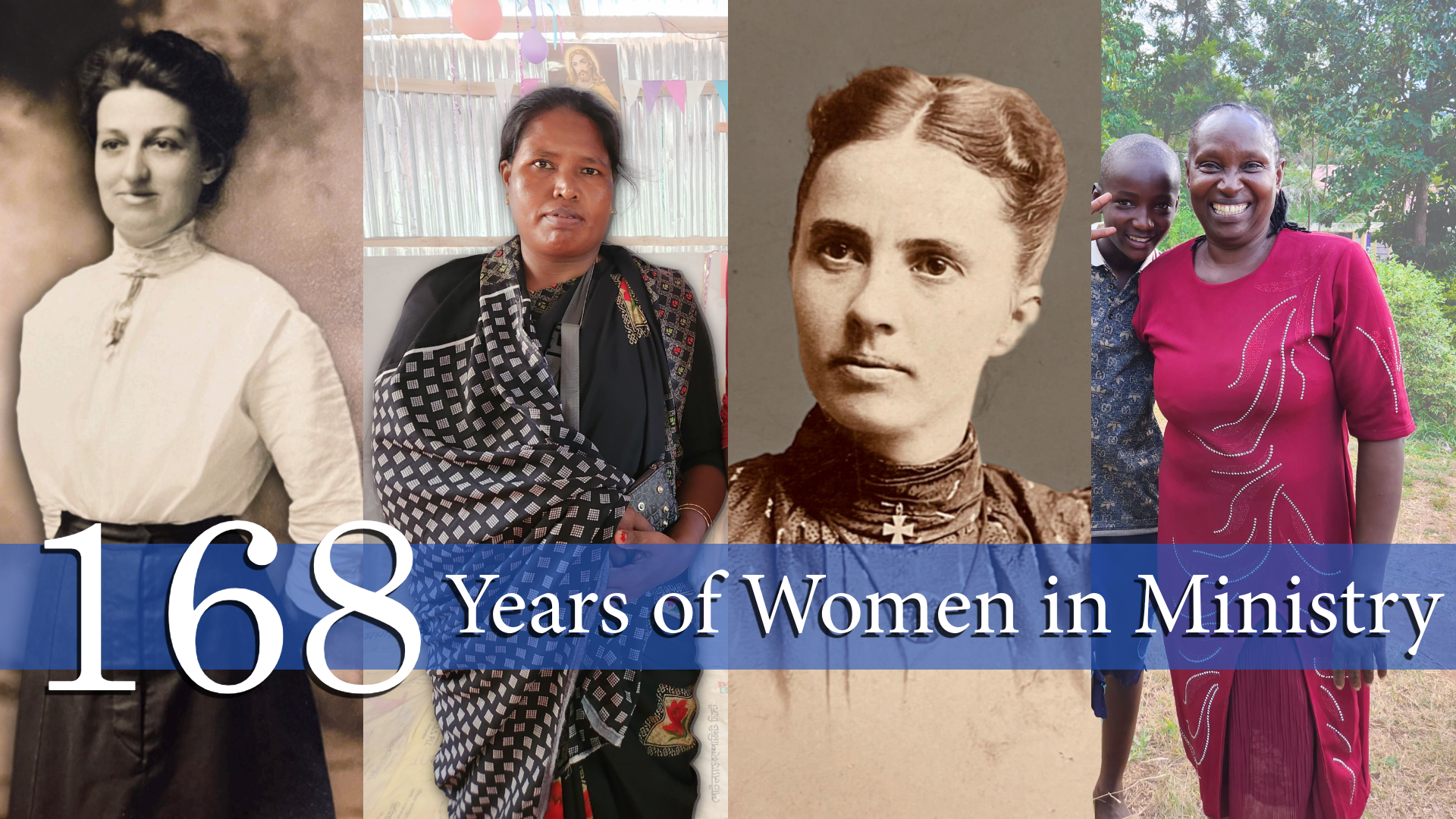
Much has been said about women in ministry in the last two weeks. Based on the most recent decision by Southern Baptist Convention (SBC), many people have turned to social media, articles, and videos attacking or defending the SBC’s decision.
The CGGC holds a clear position on women in ministry, but remains opened handed to churches that disagree, allowing meaningful disagreement and dialogue to continue taking place.
If a reader was interested hearing more about the CGGC’s formal position on women in ministry, one could read our We Believe and Here We Stand on our website, which both address this idea, as well as A Defense of Women in Ministry, a clearly stated argument produced by pastors in the CGGC and approved for display on our website by the CGGC Administrative Council in 2024. Rather than a formal argument, this post aims to bear witness to the women who have faithfully served the CGGC as licensed and ordained ministers.
We hold that the legacy of CGGC women and their work speak for themselves.
The first woman to be licensed to preach in the Churches of God was Sister Martha Jane Beecher in 1859 in the West Pennsylvania Eldership (now part of the Allegheny Region in the CGGC). C.H. Forney recounts this series of events and how the decision came to be in his History of the Churches of God in United States of North America, published in 1914. In his section on the West Pennsylvania Eldership, Forney writes that, in 1858:
“The Eldership made a broad and luminous deliverance on the subject of female preaching, declaring that it ‘believes female preaching scriptural and beneficial to the furtherance of the work of God.’ Hence is resolved ‘that we vote (upon application) a recommendation to all sisters laboring in the gospel, whose qualifications and religious character will justify us in so doing.’”
The following year, Sister Martha Jane Beecher was given a certificate to preach and continue to maintain her license in the eldership. By 1864, Beecher reported to the eldership that she had preached “105 sermons that year”. She worked in various circuits across the West Pennsylvania eldership until 1865, when she married and moved to Iowa, wherein she immediately joined the Iowa Eldership of the Churches of God. Forney writes that upon arriving in Iowa in 1866, “the Eldership desired to hear its first sermon by a sister, and at once ‘appointed her to occupy the pulpit’ on Monday evening.” Beecher is mentioned again in the Iowa Eldership in 1878, and as a “regularly licensed women of the eldership” in 1899.
All told, after Beecher’s arrival in Iowa, numerous women were licensed in the Eldership, some as missionaries, some as evangelists, but many as preachers in pulpits and circuits around Iowa. At the Iowa Eldership meeting in 1900, of the 41 licensed pastors, 6 were women.
In 1884, John R. H. Latchaw, pastor and first President of the Findlay College (now the University of Findlay), wrote in the Church Advocate that the Free Baptist Foreign Mission Board had reached out to cooperate with the Churches of God in South Asia, saying:
“Their proposal was to grant us the privilege of cooperating with them in their foreign field….
They are not necessitated to make this offer to us. But the urgent cries from the unknown said millions within their territory impel them to say to someone, “come over and help us!”, This invitation has reached our ears. We, with one voice have pronounced it a “rare opportunity”…
Now the question arises—are we ready and willing to seize it, or will we suffer it to go by unimproved?”
Around this time, the importance of women ministers would be felt extra ordinarily in the form of our first oversee missionaries, namely Clara Landes and following soon after, Viola (Hershey) Cover.
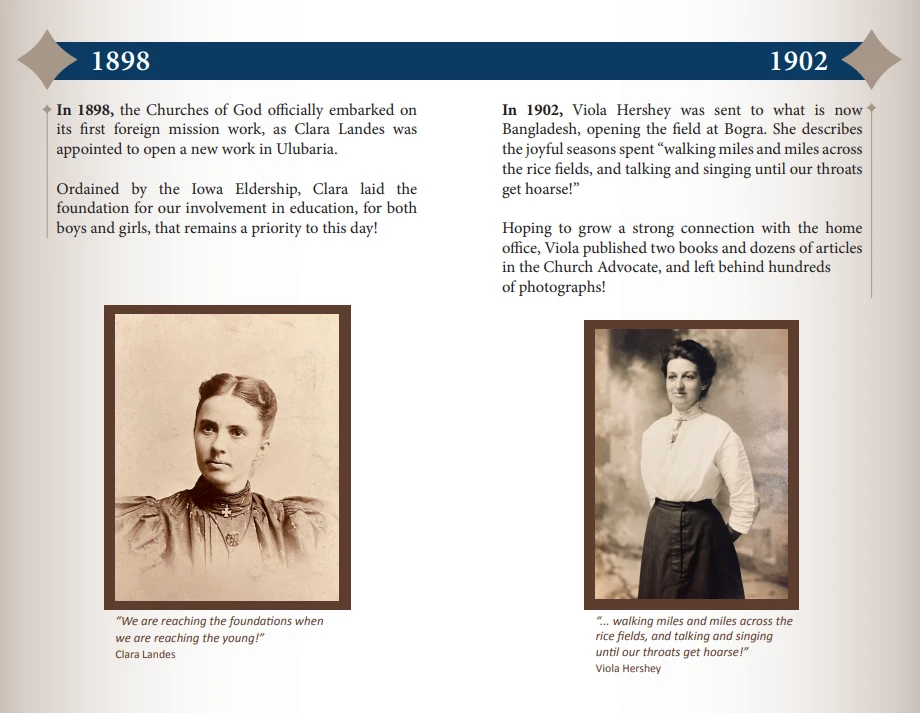
Clara Landes became our first missionary, sent by the Church of God’s Women’s General Mission Society (WGMS) in 1896 in partnership with a Baptist mission in South Asia. All missionary work in the Churches of God was handed over to this women’s society and their local chapters, highlighting the trust and import the Churches of God felt women’s work held in the ministry. Two years later, Clara had established an independent Church of God mission where she began evangelizing through preaching and printed materials to village people in South Asia.
The Iowa Eldership continued to champion Clara and in 1903 said that they shared “joy in her victories for Christ and the Church”, recognizing her outstanding contribution to the kingdom through her missions work in Asia.
100 years after she started her ministry in South Asia, the Churches of God would have nearly 200 churches across the region, two hospitals that serve hundreds of thousands of people, and dozens of schools that serve thousands of students. Thousands of people had been brought to Christ. Now, more than 125 years later, those figures, and the eternal impact of Clara’s work, continues to grow and expand.
Viola (Hershey) Cover would begin her mission work in South Central Asia in 1902. Much of Viola’s work encompassed evangelizing the people. Viola remarked in 1912 that, “This valuable mission field, so close to [South Asia], with such good railroad facilities, splendid roads and generous hearted people, was left unoccupied for such a long time. We are the only missionaries working in the field and are responsible for bringing them the gospel.” Indeed, the people of South Central Asia were more isolated from the Gospel than one might first imagine. In South Central Asia during this time, women were often sequestered away in to “zenanas”, a room in a home inaccessible to men or people generally, often without windows. In this culture, only a women preacher could gain access to other women to share the gospel.
In one of her books, Viola recounts that,
“Because the women are not allowed to come out to our church services to hear the Gospel, we must take it to them in their homes. That means we must go from house to house, village to village, to sing to them the message of the cross, to teach them about Jesus, to sell Gospels and distribute leaflets among them”. – Glimpses of [South Central Asia] by Viola G. Hershey.
In 1912, Viola was married to Howard Cover, and the pair returned to South Central Asia, continuing their ministry together. Viola herself would spend 44 years as a missionary.
Beginning in 1938, Dr. Fidelia Gilbert served as the CGGC’s first medical missionary, working primarily in South Central Asia. In his book The World Was Not Worthy: Portraits of Five Women Missionaries, former Global Reach Director Don Dennison recounts much of Dr. Gilbert’s life story, the tireless work of caring for and educating people in South Central Asia, and helping them to understand that western medicine was reliable and safe. Though medicine was her craft, she was determined to go to the mission field regardless of whether she was able to go to medical school, and this was evident in her ministry.
You can watch video interviews pulled from our CGGC Archives Museum which includes Dr. Gilbert, and many more medical staff during this time.
Don Dennison wrote that, “She frequently preached in Sunday School, to the women’s group, and to the hospital workers in the Chapel. The Church of God [in South Central Asia] elected her to be an honorary life elder, an unusual recognition in a male-dominated society.” Dr. Gilbert stayed at her post in South Central Asia during the war, even when she was encouraged to flee. When fighting grew near to the hospital, Dr. Gilbert met once with an Army Colonel who “expressed great respect for Fidelia” due to how the work she had done, and how long she had been serving the country. By staying through the intensity of the fighting, when food was scarce and shells sometimes hit the hospital building, Dr. Gilbert said that, “I stayed to give courage and, if God willed, protection to Christian friends so that there would be a nucleus of people left to carry on the witness during and after the struggle.” Outside of furloughs, Dr. Gilbert would remain an active missionary until her retirement in 1972, having served for 34 years and through 3 wars that ravaged South Asia and South Central Asia.
Rhoda Kauffman, like both Clara Landes and Viola Hershey before her, prepared for her missionary career by first attending the Findlay College (the Churches of God’s college, at the time). Rhoda graduated in 1941, continued her education at Millersville State Teacher’s College through 1943, and set sail for South Central Asia in 1944, deep in the midst of World War II and despite the threat of the Japanese Navy. In South Central Asia, Rhoda Kauffman would become the school supervisor.
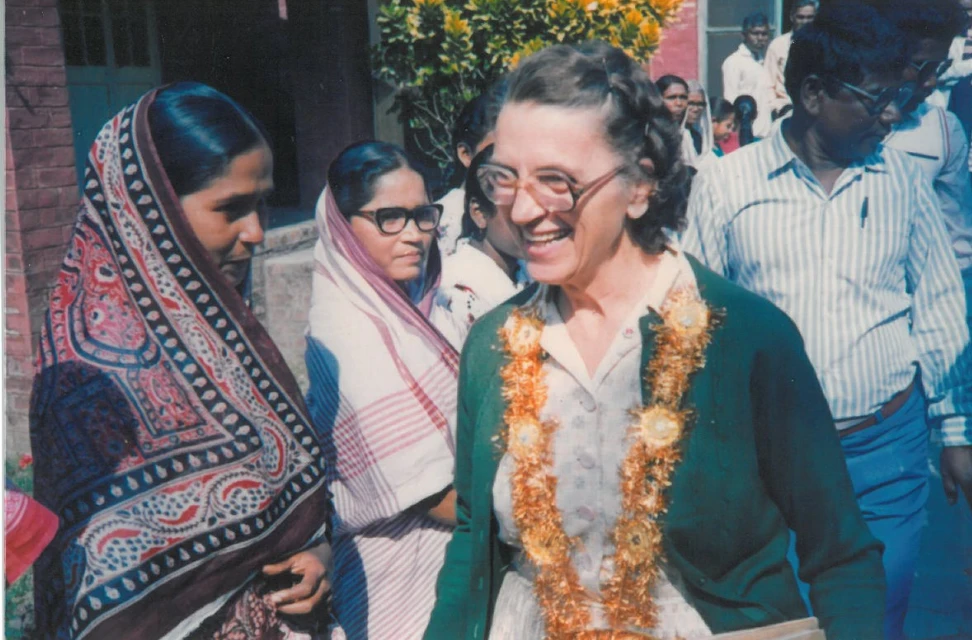 Rhoda Kauffman in South Central Asia
Like the missionaries before her, Rhoda often lived in a mud hut and rode from village to village on her bicycle, loaded with bibles, tracts, blankets, and more. Don Dennison knew Rhoda personally and also wrote about her in The World Was Not Worthy saying that, “there she lived an even more simple lifestyle and ate simple food…and loved every minute of it.” At age 66, Rhoda was still riding her fully loaded bike 30+ miles a day, meeting the needs of the churches and school. Dennison also records that Rhoda,
“began women’s meetings, children’s meetings, instructed Bible women (evangelists), taught Sunday School classes, directed bible courses in the schools, and taught church membership classes.”
“When she retired in 1986, it could be said that all the present church leaders, school teachers, preachers, and even hospital workers have been brought up under her care.” You can purchase a physical copy of The World Was Not Worthy: Portraits of Five Women Missionaries by Don Dennison on our online store.
These brief accounts herald only a small fraction of the professional, licensed ministry work of CGGC women. All of the women who we’ve highlighted today are now gone, but the legacy of their work remains and flourishes.
On their shoulders now stand many, many women pastors, missionaries, worship leaders, youth and children ministry directors, and more who are vital to the Kingdom work the CGGC does. Quality preachers, teachers and faithful Christian leaders are needed now perhaps more than ever, and we are grateful for the women who have stepped forward and accepted the call placed upon their lives.
CGGC eNews—Vol. 20, No. 25


Login To Leave Comment