
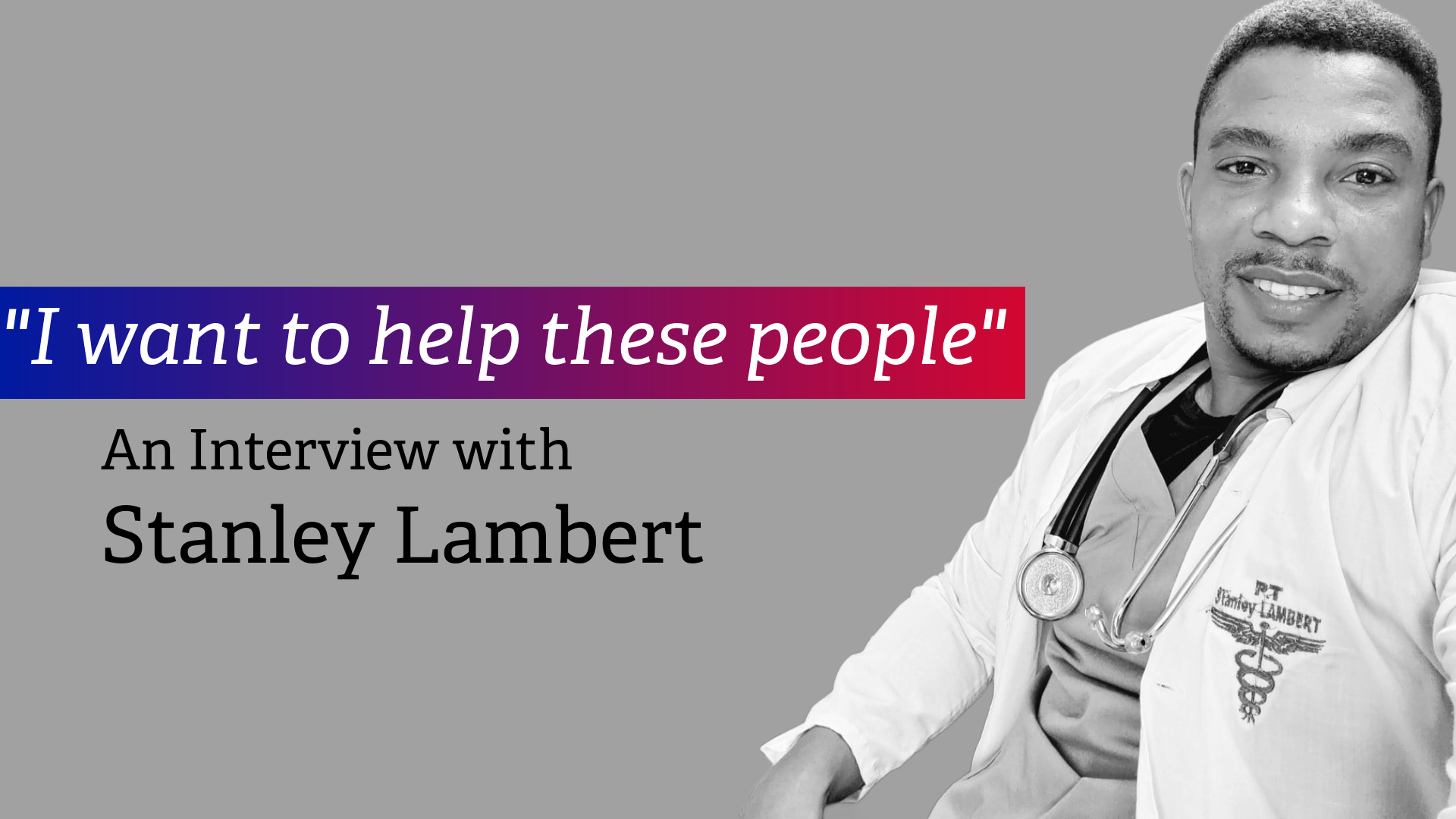
Stanley Lambert joined our team in 2025 as a remote PHH (Project Help Haiti) Mission Coordinator. We’ve been thrilled to have Stanley on our team and to meet him at conferences and over web meetings, but not everyone in the CGGC has had that privilege. So, we asked Stanley to do an interview to discuss his role, the work he does, and how he helps connect people in the United States with needs on the ground in Haiti.
You can read more about Stanley on our website, and view his most recent support letters here: Stanley Lambert Support Page
Can you tell me about how you came to work with PHH and how that transitioned to your job as the Hospital Administrator?
The earthquake on January 12, 2010, that's when I developed the sense that I wanted to become a physical therapist, because after the earthquake, you know, thousands of souls [were] lost that day. And then I wanted to help some of those people that were paralyzed. They [were] suffering a lot. I wanted to help, but I could not help them. And I felt like “Lord, I want to help those people. I want to be in a position where I can help those people.”
They have nobody to help them, and I wanted to help them, but I couldn't. And since then, I started doing some research to learn to help those people, and that's when I found out that physical therapy is something that will really help.
But at that time, we did not have a physical therapist school in the country, except for the one in St. Mark that Project Help Haiti has. And when I went to St. Mark, I [met] the director of the school, and that's when I [began] taking the course.
I began working with Binkley Hospital in Pierre Payen as a Hospital Administrator, which is the CGGC Missions Hospital in Haiti. Prior to that, I graduated from Project Help Haiti Physical Therapy School. The one that Jean Weaver is managing and over time I developed relationships with PHH leaders like Pastor Dennis and of course Jean Weaver.
Through a strong calling to serve Haiti in practical and spiritual ways, I became involved in mission coordination, medical outreach, and community development.
And I should say that Pastor Dennis is the first one who told me, “man, I see your leadership. I don't know if you have the right knowledge to be the administrator of the hospital, but someone like you would be wonderful because I see your leadership.”
I told him that I did have a background in business administration and Jean Weaver was the first one who told me to apply for it. “Apply for this job, you never know”, she said. And I applied and thank God I got that job. I spent almost two years in that position.
Can you give us an overview of your role now as PHH Mission Coordinator working from the United States?
So as mission coordinator, my work centers on connecting the vision of Project Help Haiti with real names on the ground. So even from the United States, my niche is communication with Haitian leaders. I am coordinating the medical and educational projects there and I oversee reports, plan goals, and work closely with supporters and churches here too.
And I should say that being here, it certainly allows me to advocate more effectively because it helps me to provide updates, develop partnerships, and ensure that all our ministry areas like Medical education, community development, and church growth are moving forward with clear direction.
What does your work look like day by day?
On a typical day, I begin by communicating with our Haitian field, like Pastor Dennis and those that are responsible for the hospitals. We have Jean Weaver for the physical therapy school. So her and I, I almost every week I have meetings with her, with the staff, and I'm also translator for her. I am translating for her every time she has to talk to the staff in the school.
I review updates on the medical clinic, of the schools, church activities, or community projects. Then I spend time organizing documents, planning project timelines and preparing reports. Check my emails, respond to emails, etc.
That's in the morning, but in the afternoon, what I do is I often work on administrative tasks, like team coordination. I help with budgeting like with the hospital right now. We do not have hospital administrators, so I'm the one that helps with a lot of that kind of stuff, like when they have to make a decision, they want to do something, I am guiding them, I help them with, you know, budgeting and stuff like that. And I also stay available for problem solving because things come up all the time, especially in the time that we are living in Haiti since the gangs took over.
So, every time there was something, I'm the one that they call and I'm the one to answer to tell them what to do and especially when emergencies come up, like I said, much of my work is making sure the vision stays clear and the communication stays strong and the projects stay on track.
 Stanley and Marie Lambert recently welcomed their 4th child, 4 month old Chloe.
How does living in the United States either help or hinder the work that you do?
I feel like I'm like a catalyst being here in the United States. It helps a lot because not only it has helped me to connect with those people or those amazing donors that we have here so I can let them know what's happening there. And sometimes they need to hear this from a Haitian.
They need to hear this from someone who's living the situation in Haiti, to describe it for them. So, I think it is really crucial. I not only I understand the culture in Haiti, I speak the languages. And I know the challenges there and I think all that allows me to advocate accurately and help bring meaningful resources where they need to be most in Haiti.
And I think my role is vital because I serve as the bridge between the teams in Haiti and the leadership here in the United States. And I think without strong coordination, communication and planning, the work in Haiti can slow down or lose direction. I help keep everyone aligned, informed and supported so the mission can move forward consistently.
God is using me to help bring in the information about what happening there so that they can get some help. And I feel like with me being here in the United States, we help a lot with those people [in Haiti].
For example, in La Gonâve, those people, they were starving and it was really hard for them and the time when we sent food there... Man, if you could see how happy those people are, how they are praising God, thanking God for this. And I do believe if I was not here, it would be very difficult to get that news over here and to help [Haitians] get something.
I grew up in La Gonâve (Gonâve Island, Haiti). I know a lot of challenges that we have, and I do have some of my colleagues, my teachers, my pastors there. They usually help me with the right information about what is happening there.
La Gonâve is the most isolated area in Haiti. So, missionaries, they would not go there. Even kids, after they leave La Gonâve to go to Port-au-Prince for school, they don't want to go back there again because there are no resources. The government is not effective there and the poverty is really extreme in this area, on the island.
Also, I think [if I were still in Haiti] I would be one of the victims. I would be a victim because people know the fact that I was administrator of the hospital that I'm the one to go to, and it was very dangerous for me there. So, I would not be able to help them in anything, but being here, it's very good for them because they still have some hope.
What are some of the biggest challenges you’ve faced in this role?
One of the greatest challenges I have faced recently is the impact of rising violence and instability in our region in St. Mark and Moreau.
About six months ago, I had to make a very difficult decision. I had to let go of more than 70 employees and just last week I had to release 30 more employees in the hospital. We are experiencing a significant decrease in patients because many people, they are afraid to travel and that caused our financial capacity to drop sharply. Because the gangs, they are around our hospital, the people, they are afraid if they go there, they might be in trouble, so they don't come.
As a leader, we had to make decisions based on the reality of the moment. We did not want to fall into debt with our employees or create promises that we could not keep. And still, it was very painful because I know these staff members, they have families, they have responsibilities and they have limited opportunities.
So, I'm certain that hunger and hardship are increasing for many of them and that weighs heavily on us. Situations like this, they require my constant intervention and I work closely with Pastor Dennis, the staff, and leadership to navigate these crises, make responsible decisions, and support people as much as possible.
But beyond hospital operations, I also help the mission identify where community outreach is needed. For example, right now we have thousands of Haitians [that] are displaced in Saint Mark. Those families they are living in a public park. I help coordinate responses like connect with partners and make decisions about how we can bring it to those suffering the most. This part of my work is extremely challenging, emotionally and operationally, but it is also where I feel like my calling is the strongest; to lead with compassion, make responsible decisions, and do everything possible to bring relief and help to our Haitian communities.
What is the emotional toll like? As you take all these calls from people in Haiti who are struggling?
It was two weeks ago when gangs took over Pont-Sondé. Pont-Sondé is 15 to 20 minutes from Saint Mark.
[The gangs] started burning those houses, and the people, some of them, they killed them there and most of them had to flee and they went to Saint Mark. So, that's when they call me, people call me and tell me about it and I have pictures, they sent me pictures, and when I saw that, I called them on video during the day and see what's happening and see the people there. And it's really hard to see how people are struggling, people with babies in their you know arms.
In the street, in the park, not having somewhere to stay. They don't know what they're going to eat. They have just one pair of clothes on them and they don't have a bathroom that they can go to. They don't know how they're going to shower. Anything like that.
It's just hard and emotionally it affects me a lot. I pray that God helps those people, but this is hell. It's like hell.
It's really hard and those are the parts that hurt me the most because I love Haitian people and I know we don't need much to be happy. We just need something to eat during the day and we're already happy. We are excited. We are praising God. We are thanking God. That's what we need. We don't need a lot. We don't need a lot of resources. We don't need cars. We don't need any luxury stuff.
They like to work. They're hard workers, but we don't have those kind of possibilities and seeing that kind of stuff… it's really hard. And the babies… they did not choose where to be born. They did not choose this situation. Man, it's really hard.
Any final comments?
Most importantly, please ask for prayers for us down there, because I do believe what goes up must come down.
The situation there, it's awful. It's really hard and it's not something humans should be facing. So and I know that a lot of Haitians, some of them, they think that God forgot about them. But when they said that, this is what I think. I reflect on the time when the Israelite people were in Egypt for at least 400 years, and I'm thinking about those people. They might have said the same thing that Haitians are thinking right now, like, “where is our God? “Why has He left us in this situation and is not doing anything.”
So, I think it's not that God forgot about them. God loves all of us and I think this is the time where God would hold us accountable. Us Christians, we have opportunities. When God blesses us with something, it's still God’s; it still belongs to God. It's God money, it's God resources. He wants to see how much we care for each other; how much do we love each other. Because Jesus said if you love me, obey my commands. And he wants us to love those people.
Stanley and his wife, Marie, have 4 children, Princess, Brittany, Kaylee, and Chloe, all girls, ages 12, 8, 6, with Chloe being just 4 months old this December.
Will you support Stanley and the work he's doing to help our hospital, schools, and churches in Haiti in these trying times? Stanley's support is entirely supported through donations and recurring giving but Stanley has yet to be fully funded. A donation toward Stanley is an investment into kingdom work in Haiti!
Click here to go to Stanley' Support page, or donate directly below: Stanley Lambert Support Page
CGGC eNews—Vol. 20, No. 1

Login To Leave Comment