
Artificial Intelligence (AI), in its myriad forms, continues to dominate headlines. Arguments about finance data and economic forecasts center around whether or not AI is a bubble, and when it will pop. Political debates center on AI regulation, competition with other nation states, and whether tax payers want more AI data centers in their back yard. It saturates advertisements in which products with no meaningful connection to AI still manage to feature “AI” prominently, like this Samsung ad for an AI washing machine, which does… something.

The technology permeates every area of online and offline discourse. From the mouths of CEOs, AI promises to increase productivity to here-to-fore unseen levels and revenue will follow. From the mouths of tech futurists, AI will transform our world, fundamentally reshaping what humans spend their lives doing.
If the world can’t stop talking about AI, it’s worth hearing what the Church has to say too. This blog has been fairly critical of AI in the past. Like in last year’s blog where I shared my pessimism for technology in general: An Overview of AI in 2025
But this week I attended a talk where a more balanced approach was detailed.
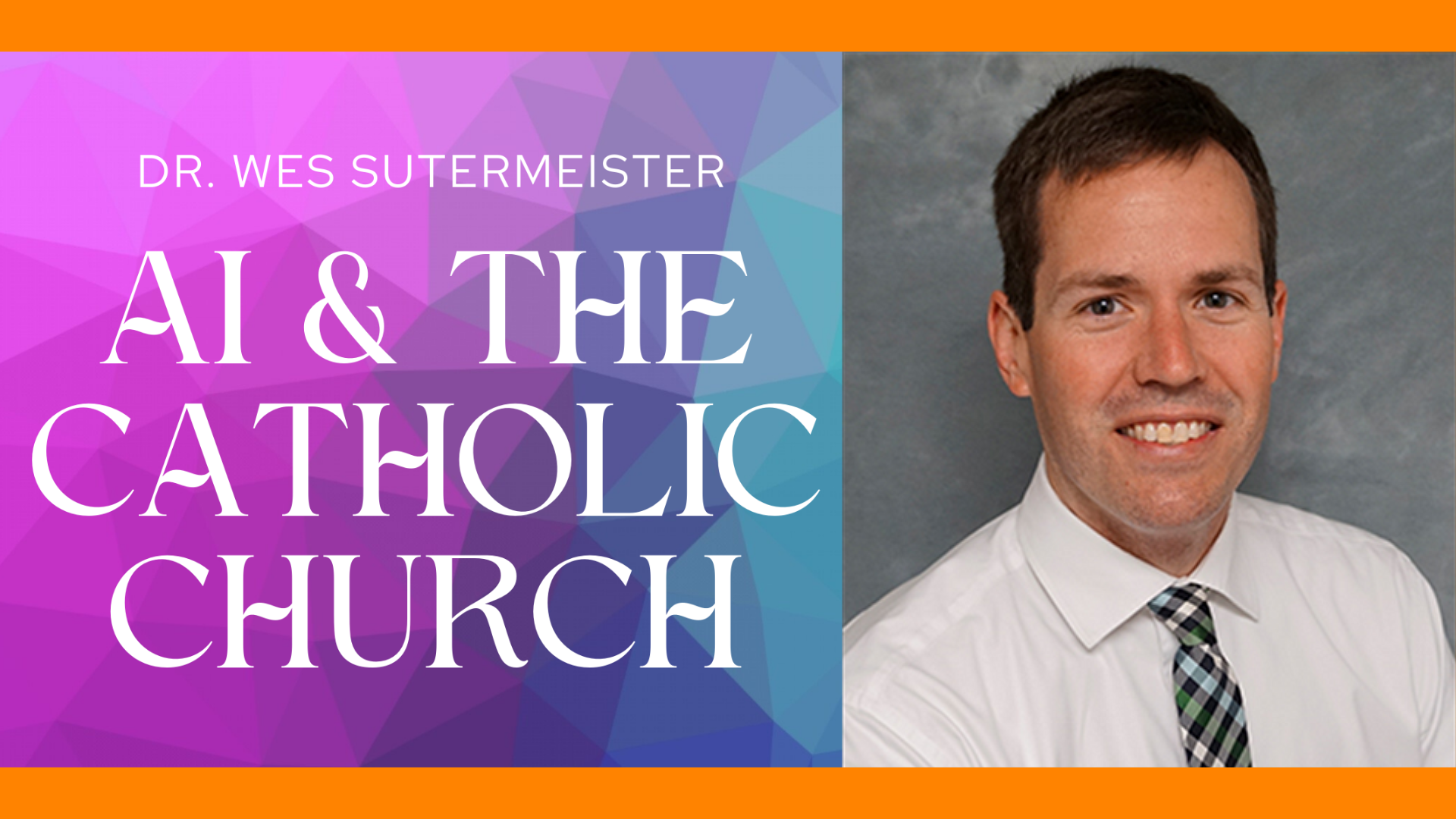
Dr. Wes Sutermeister, at the University of Findlay, recently gave a fascinating talk titled AI and the Catholic Church, in which the Assistant Professor of Religious Studies detailed the developing position of the Catholic Church on artificial intelligence.
Why is the Catholic Church’s opinion on AI important? Well, as Dr. Sutermeister points out, “The community boasts 1.4 billion practitioners around the world, making it a truly global force, and its teaching authority – known as the magisterium – has been relating questions of God, faith, and Christian religion to new developments in technology throughout its long history.”
As the largest group of Christians, and with profound religious, political, and cultural weight, when the Catholic Church speaks, many people, even non-Catholics, listen and take note. The Catholic Church uses this influence to convene people together who can work through difficult, modern issues. As an example, Dr. Sutermeister spoke briefly about The Second Vatican Council, also called Vatican II, out of which came a decree On the Media of Social Communications, in 1963. The decree established the Catholic Church’s position on the media tools of the day, and how they ought to be utilized for the betterment of the Church, saying that “It is, therefore, an inherent right of the Church to have at its disposal and to employ any of these media insofar as they are necessary or useful for the instruction of Christians and all its efforts for the welfare of souls.”
That the church should adopt novel forms of media, and the techniques to use them well, is expected. The Catholic Church, while heavily steeped in tradition, will also, like all proselytizing religious traditions, take every good opportunity to help carry its message further. Whether it’s the printing press, morse code transmitters, radio, television, and so on, the church has always used modern media and communications to advance the Kingdom. The contextualization of the Gospel is fundamental. Why should AI be any different?
On the other hand, Dr. Sutermeister demonstrated that the Catholic Church’s teaching on technology is not a full-throated support. It is thoughtful, critical, and questioning. Modern Catholic teaching asks as many questions as it answers on topics of technology and AI. The pattern looks like: point and counter point, question and counter question. The strategy requires readers to think deeply about the topic themselves, and to contribute to answering these questions in their own contexts.
Vatican secretary of culture Bishop Paul Tighe argued that AI is an opportunity for “deeper reflection on… the anthropological, the meaning of what it is to be human.”
As we interface with AI tools, we might need to challenge assumptions and definitions. Like, for instance, our concept of intelligence. As we watch AI tools do things that we believed only human intelligence could do, we have the opportunity to reconsider whether or not the term still fits. We wonder, is transcribing audio from a phone call into perfectly verbatim text worthy of “intelligence”? Instead, we might think again about what makes us distinctively human. Likewise, as we think about what being made in the “image” of God means, we wrestle with which parts of God’s image apply uniquely to us.
This concept of being image bearers was referenced in Dr. Sutermeister’s talk. “The image of humanity”, Dr. Sutermeister said, “seen reflected in the mirror of AI is partial and imperfect, and necessarily so, as theologian Noreen Herzfeld pointed out.” Herzfeld suggests that an image is always partial, just as we bare the image of God, but are not ourselves fully God, AI which bares our image is not fully human either. It’s intelligence is not fully human intelligence. Summarizing the differences, Catholic teaching suggests that these difference between human and AI intelligence amount to rationality, embodiment, relationality, transcendentality, and creative responsibility.
AI intelligence is not rational, it does not have a body and it does not act out its intelligence through a body, it is not relational, it does not seek to transcend itself or its boundaries, and it is fundamentally not creative, and not responsible for what it does create.
AI intelligence is then, “incomparable with the human ability to grasp reality,” as stated in Antiqua et Nova, a 2025 Catholic document which is specifically about the relationship between artificial intelligence and human intelligence.
Mark Graves also recognizes a gap between "computation and ethical expertise” in the world of AI technologists. While Silicon Valley may be a hotbed for AI technology development, there is a true dearth of ethical considerations. Not featured in Antiqua et Nova is the breakneck, almost nihilistic, pace of AI development which sees the game as essentially zero sum. The thinking is that if a company (or even a country) isn’t leading the AI revolution, it will be irreversibly left behind, eventually becoming extinct. This paradigm doesn’t have an allowance for ethical considerations. Without meaning to be trite, the classic line of technological overreach from Jurassic Park springs to mind, "Your scientists were so preoccupied with whether or not they could, they didn't stop to think if they should."
In light of that, the 2020 Rome Call for AI Ethics seems both ahead of its time, exceedingly prescient, and sadly left to the wayside, now 6 years later.
Called “Algor-ethics” by the late Pope Francis, Dr. Sutermeister detailed how: transparency, inclusion, responsibility, impartiality, and reliability were crucial to developing an ethical framework for AI. Without these concepts, AI would be (and has shown itself to be) unnecessarily harmful.
Present AI models are not transparent with their sources (because they are largely plagiarized), they are not inclusive (and demonstrate biases both in their training data and who will have access to these tools). AI firms wave away their responsibility for the harm caused by their tools (like the plethora of AI pornography generated of nonconsenting adults, and worse, children on X.com). AI companies have been found quite partial, scrubbing information and forcing their tools to spit out false but convenient information. And, as everyone has probably experienced, we know AI tools lack reliability when every AI agent comes with the disclaimer “AI responses may include mistakes.”
The Catholic Church seeks to be a guiding voice in continued conversations about AI ethics and use. Interpreting the thrust of the relatively new Pope Leo XIV’s comments, Dr. Sutermeister says that, “In light of this, AI must be used as a tool to help human beings know, understand, and explore the truth of reality.”
Even as the cultural impact of the church (Catholic, Orthodox, Protestant included) has waxed and waned, the church still has “extraordinary convening power…” The church can bring people together to think and act more ethically than they might otherwise. The church still maintains large cultural influence, and should use that influence to guide and aid society through change and turmoil.
Dr. Sutermeister ended his talk with a quote from Pope Leo which challenges us all to not let technology speak for us. “The challenge is not technological, but anthropological… we need faces and voices to speak for people again.”
A round of QA was held after the talk in which faculty, staff, and students were able to ask questions and dialogue with each other about how AI fits into their roles, work, and lives.
CGGC eNews—Vol. 20, No. 8

Login To Leave Comment